Petals from the Basket

Blog

I Understand

During the four weeks of June, I’m using a weekly focus based on character qualities and actions that begin with the four letters in the word June:

J — Joyful (a very misunderstood quality and a command from God) [6/1–6/8]

U — Understanding (a quality that blends empathy with compassion and love) [6/9–6/15]

N — Nice (a quality that requires sincerity) [6/16–6/22]

E — Excellent (a quality that doesn’t tell us to be the best but to give our best) [6/23–6/30]

 
Many years ago now, with the plans and purchases for my upcoming wedding nearing completion, the Lord allowed me to walk through a broken engagement. Though I now clearly see His perfect hand in both of our lives through that change of events, it was quite difficult at the time.

I spoke with family; I spoke with friends from church; I spoke with co-workers. They all cared, and they all loved me, prayed for me, or encouraged me in some way—but it never really seemed to help. Then one evening, I got a call from a friend who invited me to come over to her home and talk. I took her up on it—she was about ten years older than I was, and I knew she would be a good listener.

When I arrived at her home, she began with these words: “I understand.” Well, that sounded all well and good—but others had told me the same thing; however, they all had either boyfriends, husbands, or husbands and children, and it seemed to me that although they could offer compassion and love, they could not truly relate to my hurt. This friend was single and had never married yet, and I figured that was what she meant by saying that she “understood,” so I was willing to politely listen to her story.

This precious friend proceded to open her heart and life to me and share that she, too, had gone through the dream-changing event of a broken engagement—not that many years before. Suddenly, I felt a comforting sense of relief: the words “I understand” took on their true meaning and soothed my sad and weary heart as no other words could have.

She had walked my path. She had felt my pain. She had known my grief.

She understood.

She was the first one in that moment who could truly blend empathy with compassion and love.

My gem of a friend not only undertood; she took that first-hand knowledge and allowed God to use it to comfort me in the way she had been comforted at the time of her own broken engagement.

What sorrow has God given you comfort through that you could use to give comfort to someone else walking through that same sorrow, loss, or situation? To whom could you reach out and utter some of the most comforting words ever spoken: I understand?

All praise to God, the Father of our Lord Jesus Christ. God is our merciful Father and the source of all comfort. He comforts us in all our troubles so that we can comfort others. When they are troubled, we will be able to give them the same comfort God has given us. (2 Corinthians 1:3–4, NLT)

_____________________

Thank you for taking time to read “I Understand.”
Will you take a moment today to ask God
to show you someone that needs your
understanding comfort?
 
Do you want to read more about this unique gift of comfort?
My mom’s little book, The Death of  a Dream,
is available for purchase here.
The Roots and Fruits of Joy

Galatians 5:22-23a are very familiar verses from the Bible: “But the fruit of the Spirit is love, joy, peace, forbearance, kindness, goodness, faithfulness, 23 gentleness and self-control.” (NIV)

It was an “a-ha” moment for me when I realized that joy isn’t some perky emotion I can muster up when things are yucky. It’s a characteristic that should be present in my life—at all times. It is a fruit of what the Holy Spirit of God is doing as He works in my heart and life to keep me rooted in Christ. Joy in Him is part of the root, and joy from Him is part of the fruit! That explains why I can be sad about outward circumstances or earthly loss and yet have joy in my heart. When my joy is rooted in Christ, it’s not going anywhere—no matter what!

This also helps to clarify the untruth of the familiar expression: “it robbed me of my joy.” Only happiness can be “stolen.” When our joy is rooted in Christ, no one can steal it from us—the roots run too deep for that. Yes, we can give away our joy, but why would we ever want to do that?

Sometimes we become so overcome by our sin or our past choices that we give away our joy for a time. This is what happened to the people in Nehemiah’s day. In Nehemiah 8, Ezra was reading the Old Testament Scriptures (the Law) to the people (remember, they didn’t have personal access to BibleGateway.com or even their own copy of the Word of God), and they became so overwhelmed at the thought of their sin that God used Ezra to tell them (in verse 10): “This day is holy to our Lord. Do not grieve, for the joy of the Lord is your strength.” (NIV)

Move forward several hundred years, and believers are no longer under the Law but under the grace of God—because Jesus paid the penalty that was required by God for our sins. (Amen!) No, we don’t keep choosing sin just to get more of His grace (see Romans 6:1), but we also no longer have to plant our roots in the slippery quagmire of our past sins. We are rooted in Christ, and the fruit that grows as a result of that contains the characteristic fruit of joy! That quality of joy comes from a solid knowledge that His grace is greater than our sin—and in knowing that, we have great strength to retain our joy—no matter what!

____________________

Thank you for reading “The Roots and Fruits of Joy.”
How’s your “joy quotient” these days?
Feel free to leave a comment about how His joy
gives you strength today!


Rejoice…in the Lord

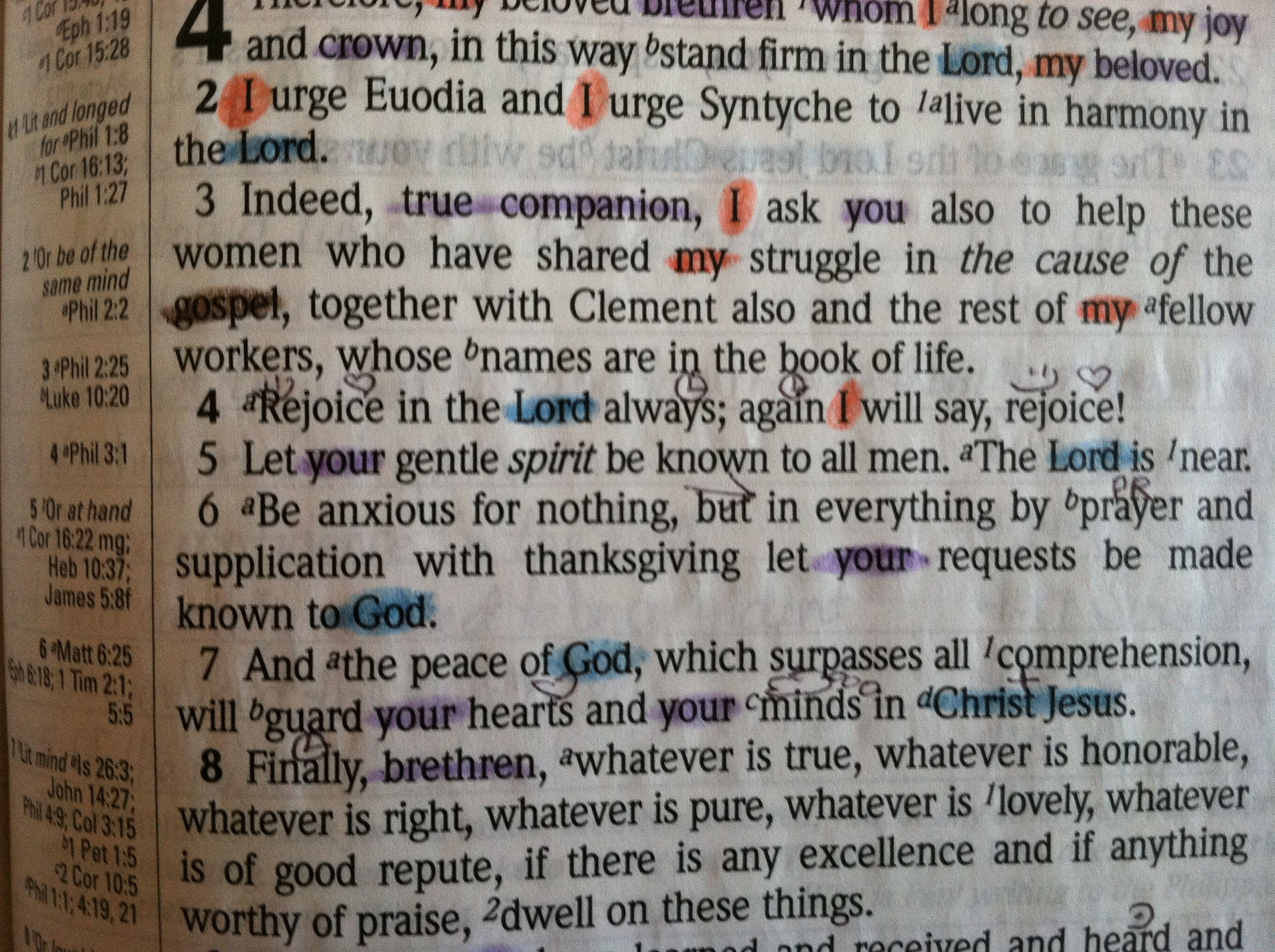
For more than twenty years, I have used the Inductive Bible Study Method taught by Kay Arthur and Precept Ministries. Part of this method includes marking key words (using symbols and colors) as you read and study the Bible. (I won’t take time to teach the Precept method; you can read more about it here.)

One of the symbols I habitually use is for the words joy and rejoice. When those words appear within a passage or verse that I am reading, I place a smiley face and a heart over the word. (See Philippians 4:4 in the photo taken of this passage in my Bible.) The very first time I marked the word joy, I simply used a smiley face; however, I returned to that verse a few minutes later to add the heart next to it. I believe that being joyful is not about being happy; it is about being happy in my heart—where circumstances, situations, and even people cannot reach in and steal that level of calm, steady, sincere happiness.

Last night, I read Habakkuk 3:17–18, and I think these verses summarize it clearly (emphasis mine).

“Though the fig tree does not bud
and there are no grapes on the vines,
though the olive crop fails
and the fields produce no food,
though there are no sheep in the pen
and no cattle in the stalls,
yet I will rejoice in the Lord,
I will be joyful in God my Savior.” —Habakkuk 3:17-18 (NIV)

In the middle of many difficulties and trials, the writer states without wavering that he will nevertheless rejoice in the Lord. He is not “happy in spite of the circumstances”; he is rejoicing “in the Lord.”

There are nine verses which use the exact phrase: “rejoice in the Lord.” (I used the KJV for looking up this phrase on BibleGateway.com for this post.) If you have a moment today, take to read them and be reminded that our joy comes not in what or who is around us. True joy—lasting, sincere joy—comes from one place: in the Lord!

  1. Psalm 33:1
    Rejoice in the Lord, O ye righteous: for praise is comely for the upright.
  2. Psalm 97:12
    Rejoice in the Lord, ye righteous; and give thanks at the remembrance of his holiness.
  3. Isaiah 41:16
    Thou shalt fan them, and the wind shall carry them away, and the whirlwind shall scatter them: and thou shalt rejoice in the Lord, and shalt glory in the Holy One of Israel.
  4. Isaiah 61:10
    I will greatly rejoice in the Lord, my soul shall be joyful in my God; for he hath clothed me with the garments of salvation, he hath covered me with the robe of righteousness, as a bridegroom decketh himself with ornaments, and as a bride adorneth herself with her jewels.
  5. Joel 2:23
    Be glad then, ye children of Zion, and rejoice in the Lord your God: for he hath given you the former rain moderately, and he will cause to come down for you the rain, the former rain, and the latter rain in the first month.
  6. Habakkuk 3:18
    Yet I will rejoice in the Lord, I will joy in the God of my salvation.
  7. Zechariah 10:7
    And they of Ephraim shall be like a mighty man, and their heart shall rejoice as through wine: yea, their children shall see it, and be glad; their heart shall rejoice in the Lord.
  8. Philippians 3:1
    Finally, my brethren, rejoice in the Lord. To write the same things to you, to me indeed is not grievous, but for you it is safe.
  9. Philippians 4:4
    Rejoice in the Lord always: and again I say, Rejoice.
    _________________________________
    Thank you for taking time to read “Rejoice…in the Lord.”
    Please feel free to leave a comment
    regarding your thoughts on happiness vs. joy.
     

Happiness and Joy

During the four weeks of June, I’m using a weekly focus based on character qualities and actions that begin with the four letters in the word June:
 
J — Joyful (a very misunderstood quality and a command from God) [6/1–6/8]
U — Understanding (a quality that blends empathy with compassion and love) [6/9–6/15]
N — Nice (a quality that requires sincerity) [6/16–6/22]
E — Excellent (a quality that doesn’t tell us to be the best but to give our best) [6/23–6/30]

A few weeks ago now, I shared a thought that I had regarding the misunderstood nature of joy. (If you missed this short post, you can read it here.) As I have continued to reflect on those thoughts, I am seeing even more that we (I) very often confuse “joyful” with “happy”—well, at least our (my) definition of “happy.” With so much emphasis on being “real” (which I believe is a good thing), it’s easy to think that if someone isn’t sobbing profusely and posting thoughts of sorrow and sadness in every Facebook update when something bad occurs that they aren’t being “real,” or that they are being “fake.”

One thing I’ve tried to do from the outset of this blog is to let what the Bible says be the final answer. Throughout the course of this week, I’m going to share my own thoughts of confusion over these terms—and their resulting thoughts—and then share the Bible’s answers to those questions and thoughts.

Though the words “glad,” “happy,” and “joy” are often interchangeable, it’s the personal filter through which we run them that determines our thoughts about them. I want to look at it more deeply than this first illustration will show, but for today, I need to wrap this up with a simple illustration of the filter through which we run our views of “happy” and “joyful.”

I generally wake up at 4:50 a.m.—not because I’m a “morning person” but because I personally love spending time with the Lord before the simple distractions of my day begin, and unlike my more self-disciplined friends, I lack the discipline to block out those distractions later in the day. Also, I like getting my work done instead of having it hang over my head. I have friends that are the exact opposite, and I have no preconceived thoughts that they are lazy or don’t love God as much as I do—in fact, I would literally find it silly to view any differences through a filter like that. As my mother recently reminded me, “different does not equal wrong.”

When I hear the alarm go off at 4:50 a.m., I’m not happy about it. In fact, I’m probably just not happy. However, I choose to start the day at that very moment by thanking the Lord for life—for the day that lies before me and the opportunities that it holds for learning more of Him. My heart is happy even when my mind is not. To me, that’s the difference. It doesn’t mean that the day ahead won’t hold problems or other things that will make me sad; it just means that in the midst of those things, I can still find joy in the Lord.

The phrase “in the Lord” is a key element of joy—but I’ll write more about that later. For now, just be reminded of the familiar words of Philippians 4:4 (KJV): “Rejoice in the Lord always: and again I say, rejoice.”

_________________

Thank you for reading “Happiness and Joy.”
Feel free to comment with something or some thought
that helps you choose joy.