Petals from the Basket

Blog

Stepping into 2021 with PURPOSE

Haphazard. Ever-changing. Putting flexibility to the test. Uncertain. And the now-dreaded word, unprecedented. For most of us, 2020 repeated these words, thoughts, and feelings far too often. It’s time for that to change.
Two days from the writing of this post, we will awaken to a new year, new prospects, new goals, and yes, new calendars, begging to be filled with the activities, appointments, meetings, obligations, and gatherings that we perhaps once dreaded but came to long for in 2020. However, writing it out, planning it, and doing it—whatever the “it” is for you—all require something further.

I believe that if we want to finish 2021 with a sense of accomplishment, we must begin the year with purpose. To do this, we will need to start each day on purpose, with purpose, and for a purpose.

  • Living on purpose – intentionally choosing our actions

This is the act of purpose. Purpose requires us to make choices—to live with intentionality. And those choices may or may not be easy ones. We will most likely make some wrong ones, but then we will choose to change, to correct, to learn, to grow. And we will choose to keep choosing—and that will propel us forward, strengthening our purpose.

  • Living with purpose – tenaciously executing our choices

This is the how of purpose. It too requires a choice: to take our intentionality and submerge it in a vat of courage. When we live with purpose, we look to the future with hope. We have a determination that enables us to carry out our plans, goals, and desires with a blend of graciousness and boldness.

  • Living for a purpose – confidently fulfilling our calling

This is the why of purpose. Though it is true that our why must be the basis for what we do, it is also important to realize that our why must provide the summary for what we did—for the choices we made and the purpose we fulfilled. As a woman of faith, I find great confidence in knowing that God has a purpose for me, and that He will accomplish that purpose in me and through me. That knowledge provides the impetus that guides me as I daily seek His great wisdom to make choices and take action.

“I cry out to God Most High,
to God who fulfills his purpose for me” (Psalm 57:2, ESV).

My prayer, as we enter 2021, is that each of us will choose to live on purpose, with a purpose, and for a purpose!


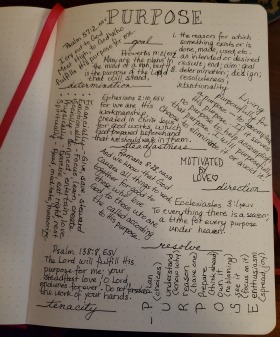
Joe and I chose to use purpose as our “word of the year” for 2021. (Hence, the rare posting from the front of my 2021 bullet journal.) Have you chosen your word yet? We’d love to hear the word you are purposefully choosing to focus on this coming year. Feel free to share it in the comments below.


Redefining Christmas in 2020

The day after we talked to my mom and mutually agreed that it was best to change our travel plans this Christmas, I knew that I had a choice to make. Oddly, it was not a choice with multiple alternatives. I had only one option: I must choose to redefine—not lower—my expectations for Christmas 2020.

My memories of Christmases past have surprisingly little to do with presents, food, locations, or activities. So filling up 2020 with “more” of any of these in order to fill a void was not among the options. So what were my expectations? How had I previously defined what Christmas was or how it should look?

For me, Christmas is family. To think that their laughter, joy, and acceptance would be withheld from me this year left me as cold as a Minnesota winter. After I hung up the phone that evening, there was a momentary icy despair that felt almost “cartoon-esque” in a “Christmas-will-have-to-be-cancelled” kind of way.

Before I continue, I will quickly clarify that as a woman of faith, I long ago acknowledged that the true meaning of Christmas lies in the birth of the Christ Child—God’s magnificent love that came down to earth via the Babe in the manger. Yet I also must acknowledge that our human traditions and customs are interwoven with our celebration of His birth, giving us purpose and hope during this annual season of remembrance and forming our expectations for the celebrations we annually enjoy.

That said, allow me to share my choice to redefine my expectations for Christmas 2020.

Expectation #1: Family must be together to celebrate Christmas.

Redefined: Even if our family can’t celebrate in the same location, we can be united in purpose, encouragement, and hope.

  • United in purpose: We are all celebrating the same occasion at the same time.
  • United through encouragement: We all want the other family members to prosper, to be in good health, and to feel the love that we have for them. We don’t have to be in the same room to be encouraged by those generous thoughts and expressions of love and kindness. Those can happen anywhere…at any time of the year!
  • United by hope: We can speak of future gatherings and know that they will be all the more delightful because of their delay.

Expectation #2: Christmas must be celebrated on either Christmas Eve or Christmas Day.

Redefined: The true meaning and spirit of Christmas cannot be defined by dates on a calendar; therefore, they can—and should—be celebrated at random.

When my siblings married and their children grew into adulthood, gathering over the Christmas holidays became more and more difficult. Thanksgiving break provided an easy solution, so we celebrated Thanksgiving on its traditional Thursday and Christmas on Friday of that week—and called it “Thanksmas!” We were together, and that, in and of itself, was cause for celebration!

However, because I did not marry until the age of fifty-five, I annually made the second trip to my parents’ home and spent Christmas with them. My brother would join us at some point during the holidays, giving us, once again, cause for celebration.

Marriage, however, changed that. I had now joined the ranks of those who had to consider the “other side” of the family. I acknowledged the traditions and timelines of my husband’s family and the extended family members of his daughter, and for the first time in fifty-five years did not spend some portion of the “two days of Christmas” with “my” family. I did not consider this a sacrifice. I considered it an act of love, making my joy all the more eager when I thought that I would be able to honor my mother and the traditions she had created in our home by spending the holidays with her this year.

Until our plans went pear-shaped.

But maybe yours did too. Or those of someone you know. And do you know what? You can celebrate Christmas in March if you want to…or May…or whenever you are together! No one—not one other being on this earth—can take away the spirit of Christmas that is in your heart, and that has nothing at all do with a calendar!

Take a moment on this Christmas Eve day to redefine your Christmas. Very few of us will have a Christmas this year that holds the same definition it has held in the past. It will look different. It will feel different. It will be different.

But you have the amazing opportunity to choose. Holding fast to your previous definitions of what this season should look like will leave you empty and, therefore, self-focused. But this is 2020. You are not alone in your need to redefine your expectations. Choose to look beyond the quietness that seems more deafening than the noise of a family gathering. Choose to hear in those silent moments the cry of the Christ Child Who had left His heavenly home for a manger…without His heavenly Father physically present. He chose love.

He came to give us that love, and that, my friend, is something to celebrate every day of the year. Christmas isn’t just family. Christmas is love—for whatever “family” (aka: friends, coworkers, neighbors, etc.) is near.

Further reading: Luke 2:1-14

Avoiding a Culture of Criticism

One of our nieces specializes in guiding corporations and corporate leaders through the process of creating a company culture that will provide opportunities for their employees to thrive. The strengths within each member of the organization, starting with the leadership team, become the catalyst for not only personal growth and advancement in the use of those strengths but often in financial growth for the company itself.

Captain Joe and I on a recent getaway to Edisto Island, SC — a great break from puppy training!

Culture. We often think of this word merely within the scope of its most common use, as defined here by Merriam Webster’s online dictionary: “the customary beliefs, social forms, and material traits of a racial, religious, or social group.” Our niece’s role is to enhance a further use of the word, found within that same list of definitions: “the set of shared attitudes, values, goals, and practices that characterizes an institution or organization.”

In this brief post, I will add yet another of the uses/definitions listed by the dictionary sited above: “the integrated pattern of human knowledge, belief, and behavior that depends upon the capacity for learning and transmitting knowledge to succeeding generations.” With that in mind, I hope that each of us will ask ourselves, “What culture am I passing along through knowledge, belief, and behavior to those in my circle of influence?”

As a woman of faith, my desire is to use my belief in God as the filter through which the knowledge I achieve, the beliefs I hold, and the behavior I both exhibit and allow into my world each day must pass. I believe that in so doing, I will create within my home and my relationships a culture of Christlikeness. For me, that is the ultimate goal.

“Have this attitude in you which was also in Christ Jesus” (Philippians 2:5, NASB). The attitude mentioned here is that of Christ lovingly, willingly, humbly giving His life for ours.

The problem for many of us, however, is that the culture of Christlikeness has been—or can too easily be—accompanied by a culture of criticism. We find ourselves stuck in a trap of using our definitions of Christlikeness (e.g., I do this; I don’t do this) rather than aligning our lives, lifestyles, and life goals with what Scripture says about Christ. In so doing, we invite a powerful culture of criticism into our home and into our relationships.

In a recent post (which you may read later, here) I introduced you to our new puppy, Kati. Yes, she’ll show up in the blog posts often, because we are learning a great deal through her—particularly about ourselves! As we continue our seemingly endless training of Kati, we are reading books, watching YouTube videos, seeking professional tips from her veterinarian, and gathering helpful advice from veteran dog owners. Perhaps one of the greatest lessons for me personally came a few weeks ago.

Through reading an article by a well-known dog trainer, I realized that Joe and I were focusing on all that Kati was doing wrong—and trying to correct it. Not a bad thing in the grand scheme of puppy training, but it definitely was not working well. In that aha moment, I decided to call her morning training sessions with me, “Yes Time.” I’m here to tell you that not only has Kati improved, but I have too! Instead of constantly correcting her wrong actions (which, yes, we still have to struggle with on a daily basis with our all-too-cute-for-her-own-good puppy), we now focus on being her confident leaders, looking for her improvements, and praising them with an enthusiastic “YES!”

It was a game changer for our training. Then last night it hit me: I must apply this same principle to the culture I create within my home and in my relationships. Yes, in my goal of Christlikeness I must see that Christ corrects, chastens, rebukes. But His motivation is love, which is also seen in His humility, compassion, listening ear, kindness, generosity, grace, and so much more. As a believer in God and in His Word, I must create and cultivate a culture in which I both present and look for the “yes” moments that align with Scripture’s definitions of Christlikeness.

Where is your focus today? Do you find yourself all too often dwelling within a culture of criticism—particularly in light of current events? Oh faith friend, if that is true of you (as it often is of me), join me today in asking God to help each of us to cultivate a culture of caring, a culture of compassion, and a culture of humble love that, by our example, leads us and future generations out of the culture of criticism and into a culture of Christlikeness.


Further reading:

Philippians 2:5-11; Colossians 3:14; 1 Corinthians 13:4-8

Motives, Control, and No Extra Credit in Heaven

If I had known her address, I’d have sent her flowers yesterday. She needed them; she deserved them; and she had earned them.

Who was she? The recipient of scolding, harsh words, and empty pat expressions to a simple comment she had put on social media. She had joined the conversation in response to a seemingly “angry-mob-inciting poll” that appeared to have been strategically placed there by a mutual acquaintance of ours.

I did not participate. I was merely reading it after the fact while scanning this particular social media site for a few moments after lunch. Because we are not connected in any way other than this, I sent her a private message of comfort and kindness that I hope she will open and read—in spite of not knowing me at all.

This poor, dear, gracious, now-verbally degraded young mom simply replied that her family cannot be out and about yet because of a health condition her child has. She was called names by some; others scolded her lack of faith; still others left anyone reading the post feeling that her status as a mom had plummeted due to her response.

And it broke my heart.

Enough to wake up and pray for her, by name, this morning.

Enough to get me wondering what possible motivation moms, grandmas, and other women of all ages could have for berating one of their own.

Enough to cause me to pray that my motives are and will be aligned with the heart of God.

Enough to blog about it today.

But that took me further down the road to the next step: Is my need for control a motive I cannot even see because the underlying impetus for my words and actions is, in actuality, my own pride?

Why, in this time of our nation’s great need and our world’s great uncertainties, must we be the ones to yell the loudest, criticize the most, judge with little information, and condemn those whose choices are outside of our sphere of comfort?

Being the one to change everyone’s minds or to share the most shocking post will bring no extra credit in heaven. In fact, our Lord, in His gracious love for us—despite our often-impure motives, our unacknowledged need for control, and our attempts to shame others into our way of thinking—tells us this:

“You shall love the Lord your God with all your heart and with all your soul and with all your strength and with all your mind, and your neighbor as yourself” (Luke 10:27, ESV).

In my time of prayer this morning, I had to confess many infractions to the above thoughts. So please, know that this is written by one who is not in turn condemning those not doing things my way or those not thinking how I think.

No, it was written by one who woke this morning, grateful for the loving, strong words of Scripture and for the reminder that we all have been granted new mercies this morning to love as God loves us.

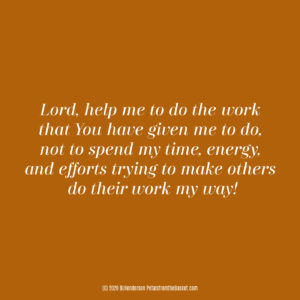
Lord, help me to do the work You have given me to do, not to spend my time, energy, and efforts trying to make others do their work my way! (See John 17:4 for Christ’s example of focusing on God’s work for Him to do.)


There are many, many more, but here are a few additional Scripture verses regarding the comments above:

*Our choice of words: Psalm 19:14

*Our motives (and God’s way of pointing them out to us): Hebrews 4:12

*Our love as a testimony of grace: 1 John 4:19-21

Lessons from a New Puppy

Bloggers set aside their blogs for various reasons: writer’s block, boredom, lack of response from readers, changes in seasons of life (and therefore changes in blog emphases), etc. In our case, the explanation is summed up in one word: puppy.

Yes, Joe and I chose (chose: a word we often remind ourselves when she’s being a true puppy) to get a dog! Her official name is Katharine Wright Henderson (her first and middle name chosen because the original Katharine Wright was sister to Orville and Wilbur!), but we all call her Kati!

We are smitten!

Life, however, must, should, and will continue, so the blog will as well, because it is where we share our lives and strive to give encouragement through the lessons God is teaching us. And He’s using Kati to teach us new lessons and lovingly remind us how very similar we are to our feisty little puppy and therefore how much we can learn from her!

For example, when we brought her home from the Greenville Humane Society, we were pretty naive. Even though both of us had adopted dogs in the past, we had forgotten that when we teach her how to do something, she won’t—I repeat, won’t—continue to do/not do that thing unless there is consistent repetition, patience, forgiveness, and a whole bunch o’ love thrown in!

Yes, that’s been a great reminder for me of how God treats us: consistently teaching us, patiently guiding us, forgiving us because of His great mercy, and loving us with an unconditional love that cannot be measured. His mercy, love, and grace abound!

Yes, Kati needs us to love on her, but I think it’s God’s love for us that will be the greatest lesson we can learn from Kati. And here we thought we would be the ones doing all the training!

[Click here to read Ephesians 2:1-9 on BibleGateway.com. This passage from the Bible sums this up beautifully.]