
Petals from the Basket

Blog

Grandma’s Here to Answer Your Questions!

Dear Grandma,

First let me express my heartfelt sympathy for your recent loss of your beloved husband. It has been my privilege to pray for you all and follow along for a few months with the blog. I rejoice with you that he is now in heaven rejoicing with the saints who have gone before us—my precious mom being one of them. And what a faith-filled and faithful life to Christ he lived. Praise God!

I’ll get right to my question: After living with a person with PD [Parkinson’s disease], what advice would you give me for the journey? My husband was [recently] diagnosed with PD…I have read much to gain understanding and how to help but would appreciate wisdom from a godly woman who has gone through the experience.

Thank you so much.

~~~~~~~~~

Grandma says:

Thank you for your kind words of sympathy. What a blessing it is to know that others care.

I recall first hearing from our neurologist that my husband had Parkinson’s disease. My mind immediately envisioned someone we knew who had a consuming type of Parkinson’s and whose family was devastated. I was pleased to have our doctor say that no two patients are alike. So first of all, don’t compare your husband with any other Parkinson’s patients.

Life is fleeting for each of us. Be sure that eternal things are cared for: first of all, salvation. Try to care for broken relationships so that your lives are free to face each challenge as it appears.

We found that home nursing care through our local hospital was a tremendous help. [When you call, ask if they offer “palliative care.” You may also click here to learn more about palliative care and to see if it is available in your area.] In my husband’s final months, the local hospital’s home hospice care was a true blessing. They were a teaching, caring, and comforting cluster of professionals. We truly felt that their presence was like having family here who loved and wanted the best for my husband.

Ben often mentioned how thankful he was that he did not have pain with his situation. He had weakness, but he did not have pain.

Get on the mailing list for the Parkinson’s Disease Foundation right away. Each of their newsletters contained at least one piece of information that we could apply to my husband’s journey at that time. [You can click here to visit the website for the PDF and order free informative materials, including their newsletter.]

We were able to keep my husband in our home until his death, thanks to a supportive, involved family. Even with that support, not everyone chooses to or is able to do that. You want whatever is best for your loved one. For some, that may be nursing home care in a carefully chosen care facility. Advice will be abundant, but at the end of the day, you must do whatever is best for him and for you.

Be alert to his symptoms. [These are available on the Parkinson’s Disease Foundation’s website mentioned above.] Do not be embarrassed about seeking advice, as needed, from your doctor. Swallowing becomes very difficult for most people with PD, so be prepared for this. Palliative care may have “speech therapy” available to teach him some swallowing exercises, which we found very beneficial. However, if or when he begins to drool without the ability to control this, help him to understand that this is a normal part of the disease and let him know that you understand that he is not doing this intentionally. It happens. If you face his symptoms with understanding and not embarrassment for him, others will react in the same way.

Be patient. Things that used to come easily will now take more time to accomplish or to understand. If you will build this added time into your schedule and allow for this, there is less stress or pressure for your patient to be expected to do what he is no longer capable of doing.

At a certain point—and you will know when that is—he will become your first priority. Sometimes, that literally means 24–7 care. Your second priority, I believe, is maintaining order in your home. Routine and structure are imperative for Parkinson’s patients, and a well-ordered home helps make that aspect easier for everyone.

Develop activities that will help to pass the long, quiet hours for a chair- or bed-bound patient. We loved reviewing memorized Scripture; reading the Bible together (in late months from an easily understood and concisely written children’s Bible story book); singing favorite hymns, choruses, and songs from years gone by; remembering events from the past; and I often sought his advice on some of the choices to be made for things like what to have for supper, what he wanted to wear the next day, and a plethera of other topics that fit his interests and desires. (These are not choices regarding death and funerals; that should be cared for at the earliest possible time).

My husband rejoiced often in the faithfulness of God, and I also rejoice in the faithfulness of my husband.

May your journey together be filled with sweet fellowship so that there are no regrets.

With love,

Grandma (Lorraine)

Do you have a question for Grandma (about marriage, children, women’s groups, being a caregiver, etc.)?

Send your question to: Grandma@PetalsfromtheBasket.com

__________

*Petals from the Basket, PetalsfromtheBasket.com, Brenda Strohbehn, and Lorraine Strohbehn accept no legal liability for the answers given in the “Ask Grandma” posts. We reserve the right to refuse inappropriate content and will deny access to false or contrived e-mail addresses. Additionally, should the e-mails we receive in conjunction with this site or this series of posts contain information regarding illegal activity or actions that would cause injury to the sender or to others, the required legal action and reporting will occur.

 

“I’m Sorry for Your Loss”

Last week we probably made close to one hundred phone calls, informing businesses, organizations, and others of my father’s recent death. Most of these were for the purpose of changing names on the accounts, closing the accounts, or merely updating the necessary information on the accounts. We dotted the i and crossed the t on every call to make sure that everything was done legally, ethically, and in the way my father and mother had predetermined. My sister Marcia had created a spreadsheet with all of the necessary information, and that was a huge help in completing this seemingly monumental task in a comparatively short time.

Though it will sound like an overdramatization of truth, as we called the various offices, it was overwhelming to hear nearly every single person on the other end of the phone start by saying, “Before I provide your answer, let me say that I’m sorry for your loss.” Some worded it with, “Please know first of all that you have our sympathies” or other such wording. We received handwritten cards of condolence from our local pharmacy, some of Dad’s doctors, and the hospice providers, each conveying their sympathies and containing a personalized comment about Dad. These organizations and individuals are among the busiest around, yet they took that single moment to honor an individual and acknowledge a loss. We were in a hurry; they were in a hurry, but it spoke volumes that they took that “nth” of a minute to make the comment. Whether it was done for “PR” reasons or because of thoughtfulness, it still spoke volumes.

In fact, we found ourselves unintentionally noting the absence of the comment when it was missing from the call. And in our very human hearts, it was easy to think, “I’ll do business with this pharmacy and not that one” or “I’d rather keep my money at this bank than that one,” simply based on the little touch of courtesy that was present in the five little words: “I’m sorry for your loss,” which, by the way, take less than two seconds to say! And may I say with a heart full of the highest amount of love I can offer: this is especially necessary for faith-based organizations to implement—no, let me rephrase that: it’s imperative—because your secular counterparts are doing it well and doing it right.

As I’ve thought about this the last few days, I have been reminded of the need to take those few extra seconds to sincerely demonstrate concern, joy, sorrow, gratitude, or whatever the speaker’s words call for as I truly listen to others. I say “truly listen,” because though we often hear words, we are often guilty of not listening to those words. Because we want to be like Christ, we should also want to follow His example, given to us through the record of His childhood visit to the church leaders: “After three days they found him in the temple courts, sitting among the teachers, listening to them and asking them questions” (Luke 2:46, NIV). By the way, the order in which this was done—listening and then asking—is a ginormous lesson in itself!

It’s not rocket science or some earth-shattering breakthrough in the world of blogging, I know. But it’s a life lesson. And it matters.

____________________

Photo credit: vgstudio, via Shutterstock.com

Do You Have a Question for Grandma?

In my father’s final months and weeks of life, it was extremely helpful to have a resource page from our hospice care notebook that listed several common “end stage” actions or symptoms that most people go through. These included things from a decrease in appetite to a lessening or a loss of physical sensation to “picking” at clothing or at the sheets on the bed. One of the end-of-life indicators listed was a “surge of energy,” often called a “rally,” when the individual will talk clearly, have a clearer mind, and in general, seem to have a change for the better. With any of these, the timing can vary between patients, lasting from minutes to days.

My father had a “rally” one evening, and in that time, in gentle, relaxed, clear, soft tones, he spoke words of wisdom, advice, comfort, and encouragement. One thing he stated with great clarity, and it seemed to be the theme for all else that he said that evening: “Sometimes we have been fearful; sometimes we have been angry; but God has always been faithful.”

And from that moment forward, we claimed “the faithfulness of God” as the theme for his remaining days to his eventual passing away and then to the songs, verses, and messages given at his funeral. Because, after all, God is faithful!

Though I’ve long been a learner, that evening reminded me anew to glean wisdom and godly counsel from those who have walked and are walking their paths with hearts that seek, and therefore with lives that teach, God’s wisdom.

So I’m making an exciting announcement today! 

I asked my dear mother, Lorraine, if she would be willing and available to answer your questions via a regular post on this blog. Sometimes you wish you could have an easily accessible mentor, and though most of us sincerely long to follow the Titus 2:3-5 principle of the older women teaching the younger women, life is busy, and a weekly commitment to meet with someone doesn’t always work well in everyday life.

The “Ask Grandma” post will appear on a regular basis, and in it, Mom will answer your questions! Here’s how it will work:

  • Send your questions (currently, we will accept any appropriate subject matter) to: Grandma@PetalsfromtheBasket.com
  • Within 24 hours, you will receive a reply, informing you that we received your e-mail.
    • For everyone’s protection, we will only reply to genuine e-mails.
    • For everyone’s protection, we will only reply to e-mails from a verifiable e-mail address.
    • For everyone’s protection, we will only reply to e-mails with a real name used. (For example, “Help Me Grandma” is not a name; “Mary Smith” is—if your name is Mary Smith, that is!)
  • One letter will be chosen to be answered publicly in each “Ask Grandma” post. NO NAMES OR INITIALS WILL BE USED in the post. Your identity will remain confidential.*
So feel free to send a question for Grandma! The e-mail box is open!

Grandma@PetalsfromtheBasket.com

*Petals from the Basket, PetalsfromtheBasket.com, Brenda Strohbehn, and Lorraine Strohbehn accept no legal liability for the answers given in the “Ask Grandma” posts. We reserve the right to refuse inappropriate content and will deny access to false or contrived e-mail addresses. Additionally, should the e-mails we receive in conjunction with this site or this series of posts contain information regarding illegal activity or actions that would cause injury to the sender or to others, the required legal action and reporting will occur.

___________________________

Photo Credit: Minerva Studio, via Shutterstock.com


Both Sides of the Door

My father was a preacher, and for many years I’ve said that one of the highest compliments I could give him was to share that he was the same person in the pulpit that he was in our home: a godly, sincerely humble man, grateful for God’s grace, which he knew he needed and which he knew he could never “earn” on his own. So it was no surprise that as my family and I sat around the table the night before my father’s funeral earlier this week, I found a way to concisely share the one word or one statement that summarized something important I had learned from my dad:

“Be the same person on both sides of the door.”

There is great freedom in authenticity. I often think that it must be exhausting to be one person in front of one group and another person when with another group. No, we don’t know all people on the same level or for the same reason, so our conversations and levels of intimacy vary, depending on the relationships. But at the core of each relationship, the same person should exist within us.

We often find great comfort in the fact that “Jesus Christ is the same yesterday, today, and forever” (Hebrews 13:8, NIV). Yet those words should also serve to remind us that right beside His love, mercy, kindness, and compassion that we long to reflect in our lives, His genuine “sameness,” a demonstration of His humility, should be seen in us—from both sides of the door.

Holding Hands

Do you remember it? His hand brushed up against yours, and you knew it was about to happen—your date was about to hold your hand. As his fingers intertwined with yours, a new degree of trust, security, and sincerity was displayed. It was as though in taking your hand, there was an added level of certainty to the relationship. It was an indication that things were moving forward—that your trust was safe.

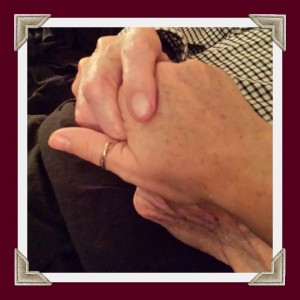
I recently snapped this photo while I was holding hands with my father at his bedside one evening. His end-stage Parkinson’s kept his hands busy that night as he tried to get out of the bed to which he is confined. Yet, when I took his hand, he gently wrapped the other around mine, and he became calm. He knew someone was there. He knew he was going to be safe, and he knew that he wasn’t alone.

I’m here for you. I love you. Stick with me. I’ll protect you. Let me show you the way. I like being with you. I’m near. These are only a few of the implied meanings from the simple act of holding hands.

Isaiah 41:13 has become one of our favorite verses in these days of counting breaths and treasuring those that are counted:

“For I am the Lord your God who takes hold of your right hand and says to you, ‘Do not fear; I will help you.'”

The security, joy, safety, and comfort that come from an almighty God telling me that our relationship is secure, that I’m not alone, and that I can find safety with Him because He is holding my hand causes me to reach out my hand to Him in faith, longing for and anticipating the help He has promised.

Reach out your hand to Him, sweet reader-friend. He is there.

_______________

You can read 52 of some of the favorite blog posts from this site in my new book,

Petals from the Basket: Devotional Thoughts for Women