September 10, 2015. Today is World Suicide Prevention Day.
STOP. I literally beg you not to log out, close this post, or predetermine that this will be a “downer” post. I need you to read this. You need you to read this. And sadly, someone you know, love, work with, go to school with, or even sit next to in church needs you to read this. Please. It looks long, and it’s longer than most of my posts, but every word was carefully chosen and works with purpose to tell the entire story. Please.
One of the rules of letter writing, blogging, etc. is to never begin your writing with an apology. It is considered a “weak” start. But I have no options, because without this apology, my words are just words. I need you to know that they have passion, conviction, and a desire to make an impact backing them up. And, sadly but truthfully, some of you will read this next paragraph and either condemn me for it or recognize yourselves in the midst of it.
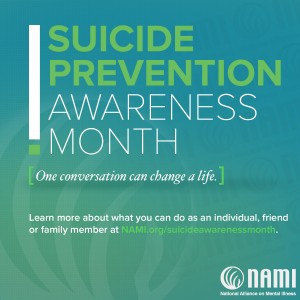 In the past eighteen years, my view of depression, mental illness, and suicide has done a 180-degree turn. Prior to that time, I was guilty of passing along an oft-quoted definition of depression that I thought was concise, and oh so Christian: the blanket statement, one-size-fits-all definition said, “Depression is nothing more than an adult temper tantrum.” Truly, it actually just brought a tear to my eye to even type that. I apologize from the very depths of my being for generalizing and sharing this (in most cases) faulty “definition” with so many people through the years. I have written long enough now to even know that some will read this post, and that definition is the only phrase they’ll remember, and they’ll misquote me on it or say that this is how I currently feel. But I’m willing to risk that in the hope that even more will recognize their own “pat-answer” thoughts on the tragically rampant symptoms and results of depression (whatever their cause—more on that in a moment) and hopefully become more aware of the needs of those around them…or of their personal need for assistance with overcoming and/or dealing with depression and mental illness.
For those already hyperventilating in their desire to “set me straight” after only one major paragraph, I will quickly address a few things in list form, and I will address them below from the viewpoint of a faith-based blogger. I will also use the terms “depression” and “mental illness” separately in order to differentiate the two. Please know that both depression and mental illness are not limited to the points in this list:
- Sometimes, in some cases, a state of depression truly is just a pity party because “I didn’t get what I wanted.”
- Sometimes depression can be caused and/or enhanced by the effects of medication or natural hormonal changes.
- Sometimes depression is an outward symptom of mental illness.
1. When we give disappointment, bitterness, selfishness, and pride a place to hang out in our hearts, we can become sad, angry, and/or depressed. More often than not, these negative elements of our lives are not avoidable. God even told us in the Bible that we will (not might) have troubles and trials:
“I have told you all this so that you may have peace in me.
Here on earth you will have many trials and sorrows.
But take heart, because I have overcome the world” (John 16:33, NLT).
In fact, notice that He even adds a quantifier: many!
But in His truly amazing grace and love, He quickly had the writer of this verse (John) write: “But take heart, because I have overcome the world.” Can I get a hallelujah? Through Him, we are overcomers. We don’t have to allow these difficulties to overtake us, because God is greater—greater than the sadness, the disappointment, the individual who is being unkind, the broken dream, the loss, etc! He is greater!
2. As my father (who passed away in January) began to decline, he needed various medications to control some of the aspects of his Parkinson’s disease. I learned so much from watching how these medications affected his day-in and day-out routines. The slightest raising or lowering of doses impacted his movements, his heart rate, and even his reactions to life around him. Those who knew my father knew that he was not perfect, but he was a sincerely godly man whose inner spirit did not change even in the worst days of his illness. However, after a few of his dosage modifications, this generally calm and gentle-spirited man would become anxious about small things. He would “fret the small stuff.” And it was a good lesson for me on the effects of medication on one’s “normal” self.
In another example of this, author, fellow believer, and combat-wounded veteran Brad C Fite, in his widely read book, Life after Death: A Survivor’s Story, boldly shares in raw detail the story of his three (thankfully failed) suicide attempts following his injury in Afghanistan, attempted in great part due to the combined effects of depression and medication.
Additionally, I will transparently tell you a true personal story. Following a major surgery that immediately threw me into the effects of normal menopausal changes, I did not have the “minor” changes that I had been warned about. Instead, the sudden changes within my physical body caused me to turn from a confident, people-loving, life-of-the-party, happy person into someone I didn’t know: I was fearful, sad, introspective, and incapable of being around new people or in new situations. I literally felt that as I went to work I was watching myself “function” as if everything were okay. But I would come home to my quiet apartment, where I was the only occupant, and sit behind my couch in silence, just hoping that no one would call, visit, or ask me to do anything. I could not sit in the large auditorium in my church for fear that I would suddenly freak out and run from the building. I sat on a couch in the general meeting area, and I generally placed my Bible next to me, trying to make it look like the seat next to me was reserved and hoping that no one would sit there! My body eventually adjusted to the major changes, and, unfortunately, some would tell you, I’m back to my happy-go-lucky self! But the overwhelming sense of depression and fear were very real and very, very strong.
3. I am not a medical doctor, a licensed psychiatrist or psychotherapist, or a certified counselor. I’m an average woman, living in a small town, with a desire to make a difference. So when it comes to mental illness, I have to rely on the professionals. But I do know this, and I am willing to state it with no reservations: We who are Christ followers (often called “believers”) have buried our heads in the sand far too long on this topic. Mental illness is real, and its effects can often be catastrophic. The remainder of this post will address those realities.
According to the National Alliance on Mental Illness (NAMI):
Suicidal thoughts can affect anyone regardless of age, gender or background. Suicide is the third leading cause of death among young people and is often the result of mental health conditions that [affect] people when they are most vulnerable. Suicidal thoughts and suicide occur too frequently but should not be considered common and can indicate more serious issues. In many cases the individuals, friends and families affected by suicide are left in [the] dark, feeling shame or stigma that prevents talking openly about issues dealing with suicide.
It’s that last sentence that we as believing people of faith need to change—today! We need to set aside the perceived “shame or stigma” that prevents us from speaking of these issues. We need our churches, our homes, our Christian schools and colleges to be places where individuals who are struggling can safely run for help, resources, and open arms of understanding and compassion.
In the case of my father’s Parkinson’s disease, no one (that I know of) said, “Oh, he must have sin in his heart, because he contracted this life-changing illness.” Yet how often do we (yes we as the church, the very body of Christ) hear of someone being diagnosed with mental illness and wonder why they don’t just “snap out of it,” “get it together,” or “stop throwing a tantrum.” But we must, we simply must, take the time to learn, to gain understanding, and to apply what we learn about this illness. It’s real. Its effects are devastating. And all too often, its results are final. Victims don’t wake up from suicide. It does not offer second chances.
As he went along, he saw a man blind from birth.
His disciples asked him, “Rabbi, who sinned, this man or his parents, that he was born blind?”
“Neither this man nor his parents sinned,” said Jesus,
“but this happened so that the works of God might be displayed in him” (John 9:1-3, NIV).
So is that it? Is suicide the only end result of mental illness and/or depression? Not by a long shot. Help is available. We as the church need to educate ourselves and those in our churches about the symptoms, the help available, and most importantly, the need to love those impacted by these real and all-too-prevalent conditions. Yes, God tells us He is the Great Physician, and I believe that by including Luke (a physician) in a very important role in Scripture, the Great Physician is allowing us to know that earthly physicians are often His vessels for providing the help and/or medication and/or healing that we so desperately need from the diseases and trials that affect us.
I will close this lengthy but oh so important post by asking you to do a few things:
- Listen to what people are telling you. Your attentive heart may be the tool that saves a life by providing love, acceptance, care, kindness, and information about resources in your area or online that you can share with the friend, family member, coworker, etc. who is hoping that you will hear what he or she is not saying. I beg of you not to assume that just because a person looks happy, seems “put together nicely,” or even serves in a position of spiritual leadership that this individual is exempt from the impact of mental illness,
- Go to the NAMI website and read the material there. You don’t have to read it all at once. Maybe focus on different links throughout the remainder of this Suicide Awareness Month. It’s imperative to familiarize yourself with resources, knowledge, and your own need to speak freely and openly about depression and mental illness. Knowledge is power, and the power of a loving, listening heart has no equal.
- Share this post with others. If you’ve read this blog at all, you know that I rarely, rarely request that. But if another believer can have his or her eyes opened to this material and the material available through the NAMI site, then I don’t mind making that simple request.
I will say that in spite of the length of this post, there is much, much more that can be said about suicide, about the lack of hope that is often the result of both depression and mental illness, and about the solace, comfort, and help that is available within the pages of God’s Word and hopefully available through our churches.
Most importantly, if you are reading these words and longing for help for your own depression, concern about mental illness, or suicidal thoughts, please know that help is available. Talk to someone. Seek counsel. There is hope.
Like this:
Like Loading...

 Yesterday in America, two members of a news team from Virginia lost their lives while in the process of broadcasting live on TV. I will watch the newsclips about their lives. I will honor their names—Alison and Adam. I will grieve in empathy with their loved ones, even though I did not know them. But I will immediately turn off the news or change the channel when information about their killer comes on. I don’t think killers deserve air time.
 I am considering doing a retreat for women with “no spouse in the house,” which would be held during the summer of 2016. Please complete the survey below and submit your form on or before midnight, Monday, August 17, 2015. From the survey participants (women only on this one, please, because the retreat will only be for women), one of you will be randomly selected to receive signed copies of Petals from the Basket: Devotional Thoughts for Women and Petals from the Basket (Book 2): Devotional Thoughts for Women. Thank you for your assistance!