Petals from the Basket

Blog

And the Award for Outstanding Graduate Goes to…

As I opened the alumni newsletter from my alma mater, I gave a quick glance to its contents and landed on the story of that month’s featured graduate. Oh, his accomplishments were noteworthy, the implied level of his salary enviable, the suit and tie he chose for the photo shoot impeccable, and, I must confess, his recognition well deserved. But as I finished the article, I sighed one of those out-loud, close-to-asthmatic-sounding sighs, wishing, as I did nearly every month, that once, just once, the featured graduate wouldn’t be selected because of his or her salary, business achievements or title, or industry-specific notoriety.

Nope. I want the featured graduates to be school teachers who have simply shown up, cared, taught, listened to, and loved their students every school day for the last fifteen years. I want the featured graduate to be the guy who used his degree to get his desired job, regardless of the salary, and who mows lawns on the weekends as a gift to three of the widows from his church. I want the featured graduate to be the husband who faithfully loves his wife, the wife who faithfully loves her husband, and the parents who are shedding tears and just hoping that, by the grace of God, they’re doing it right.

I want the featured graduates to be my sisters, my brother, my friends. You know—people who wake up, give their all, give some more, and keep growing in the knowledge of how God is using them where they are to be who they were meant to be and who they are able to be. Yes, the business leaders are great examples too, but show us people like us. People who don’t get awards for doing the right thing when no one is watching. People who won’t hear thunderous applause for keeping the house clean, getting to work on time, holding the hand of a sick child or parent, or rocking a child into the wee hours of the morning—for the fifth night in a row.

These people, the “ordinary” graduates, are heroes worthy of feature articles, yet you as the reader and I as the writer both know that it’s not likely to happen. But colleges, universities, schools, look around at your constituency. It includes the ordinary folks doing ordinary things in ordinary—and occasionally extraordinary—ways. These are the role models, the examples, the feature stories who will touch the lives of your students. These are the moms, the dads, the Sunday school teachers, the caregivers who will most greatly impact your students.

I’m not saying that business leaders, legislators, and high-ranking officials should not be featured. I’m just reminding you…no, I’m imploring you to remember…that they are only a fraction of the graduates who are excelling at what they’ve been called to do—no matter what that role may be.

So to the teachers, the moms, the dads, the aunts, the uncles, the church musicians, the community workers, the nurses, the doctors, the bus drivers, the small business owners, the guy whose name fades into the woodwork, and the girl whose name seems unknown, remember that Jesus Himself said toward the end of His life, when speaking to God the Father, the words that every graduate should be featured for being able to say, “I have glorified You on the earth. I have finished the work which You have given Me to do” (John 17:4, NKJV). Now that is a front-page-worthy life worth living!
Recipe: “Come on Over” Mini Meatloaf (and Meal Idea)

My mom knows that I say this, because she says the same thing: my mom did not make good meatloaf when I was a child, so I grew up disliking it. Only recently did I learn to enjoy it, and after gathering tidbits of helpful hints from friends, tweaking various elements from multiple sources, and creating my own unique recipe, I can tell you that this is pretty much the favorite meal at our house! In fact, Tuesday night we had this very meal, and Joe (my husband, who previously was not a major meatloaf fan himself) said, “I think if there were a TV show named Meals to Die For, this recipe would win!” (Um…love him!) Additionally, he often says that I should sell the sauce by the gallon and basically states that he would buy every gallon! Now that, my friends, makes this a meal worth blogging about, worth making, and worth saying to friends, “Come on over for some seriously tasty meatloaf!”

So here’s the point of this recipe: make it ahead in small loaf tins; freeze it; put it in the oven one hour before your meal (directly from the freezer), and enjoy a meal that you can serve to any age group at just about any time! Be sure to read the remainder of the blog post following the recipe. I share some serving ideas and entertaining thoughts to truly make this a crowd favorite!

“Come on Over” Mini Meatloaf

Prep time: 30 minutes-ish
Cooking time: 60–70 minutes, 350°
Serves: 8 (simply cut the recipe in half to make 4 Mini Meatloaves)
From the kitchen of Brenda Henderson

Ingredients:

Mini Meatloaf:

  • (Cooking spray to grease the loaf tins)
  • 2 lbs. ground beef (80/20 or 90/10…it needs a little fat in it!)
  • 2 ¼” slices of large onion, diced (optional)
  • 1 ½ cup Panko (or use croutons, place in plastic bag, and crush with a rolling pin)
  • ¼ cup ketchup
  • 1 Tbsp yellow mustard
  • 3 Tbsp brown sugar
  • 1 Tbsp apple cider vinegar
  • 1 Tbsp Worcestershire sauce
  • 1 tsp salt
  • 1 tsp black pepper
  • 4 eggs
  • 1 cup milk

Sauce (heat and drizzle over the Mini Meatloaves just prior to serving):

  • ½ cup ketchup
  • 2 Tbsp yellow mustard
  • ¼ cup brown sugar
  • 2 Tbsp apple cider vinegar
  • 2 Tbsp Worcestershire sauce
  • 1 tsp salt
  • 1 tsp black pepper

Directions:

  1. Use cooking spray to lightly grease the sides and bottoms of eight miniature loaf tins (like those that are used for bread). In a large bowl, add the Mini Meatloaf ingredients in the order in which they appear on the Ingredients list above, using your hands and/or a large wooden spoon to thoroughly mix them together.
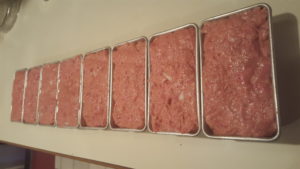
  2. Divide the mixture evenly into eight oval “loaves” and place them in the miniature loaf tins, “tweaking” the shape so that they fit securely in the tins. Cover each tin securely with plastic wrap (such as Saran® Wrap) and place each of them in the freezer.
  3. After the Mini Meatloaves are fully frozen (at least overnight), remove them from their tins and store them in an airtight container (I separate mine with waxed paper or parchment paper). DO NOT THAW BEFORE BAKING!
  4. To bake: Place frozen loaves on a cookie sheet (evenly spaced for best results). Bake at 350°— 8 loaves, 70 minutes (1 hour, ten minutes); 4 loaves, 60 minutes (one hour). Remove from oven, plate the Mini Meatloaves (do this in the kitchen) on each guest’s dinner plate, and drizzle with the heated sauce mixture. Optional: plate the side dishes as well and serve the entire meal “plated.”

Meal Idea:

Our favorite side dish for this (official hat tip to our friends Terry and Diana for this one) is to serve a baked potato with the Mini Meatloaves. Using one potato per guest, place the potatoes on a cookie sheet; they cook the exact same time and at the exact same temperature as the Mini Meatloaves, making your before-the-meal preparations minimal. In fact, if space allows, you can bake them together on the same cookie sheet. Here’s how I do my baked potatoes (though it is not original with her, my sister Karen receives the hat tip for sharing this one with me):

  1. Wash potatoes.
  2. Use a dinner fork to poke each potato in about 6–8 places around the potato.
  3. Lightly spray the outside of the potato with cooking spray (or rub with vegetable oil or olive oil).
  4. Sprinkle with coarse sea salt.
  5. Bake on a cookie sheet for one hour at 350°.

(These are soooo good! Slightly crispy outside and perfectly done inside.)

Optional toppings include: butter, sour cream, toppings (chives, bacon pieces, onion, crushed red pepper etc.), salt, and pepper. I recommend you keep it simple and only have a minimum of these options available on the dinner table.
Feel free to add a side salad, a small dish of applesauce, green beans, dinner rolls, or another side dish of your choosing. But always remember that simple is best. No more than three items on the plate is a great rule to follow!

Because this “down-home” meal is pretty filling, we generally pass a dish of miniature candy bars or a plate of cookies for dessert!

The wonderful thing about preparing the main course ahead of time (the Mini Meatloaves keep well in the freezer 4–6 weeks) is that it allows you to follow one of my most important rules for entertaining:

Spend more time with your guests than you spend in the kitchen!

__________________________

Petals from the Basket is a devotional blog that provides ideas and resources for everyday Christian living. I haven’t forgotten that! Joe and I have both been uncommonly sick in these first months of 2017 and between that and travel to visit family members, we’ve been a little negligent in keeping the blog posts consistent with our desired timing! Our general schedule goal is to post one or two devotional blogs a week and to include a “Come on Over” recipe idea on Thursdays. We know you have thousands of blog options to choose from, so we thank you for joining us at Petals from the Basket and hope that you’ll consider reading our posts here on a regular basis!

Recipe: “Come on Over” Cobbler

So here’s the wonderful thing about hospitality—you don’t have to have people over for a meal! During a time when my food budget barely allowed enough to feed me, let alone a table full of guests, my sweet mama lovingly reminded me that having guests over at 7:00 p.m. for dessert and games can be a wonderful—and inexpensive—way to entertain. She made this dessert often when I was growing up, so even though it’s not original with her, I’m crediting her for sharing this recipe with me.

This week’s “Come on Over” recipe is for one of my favorite “go-to” desserts. In fact, it’s so easy that I’ve been known to spontaneously invite someone over after an event and make it once we got home, and then we played a game or just enjoyed talking until it was ready! It’s perfect for a “dessert-only” night or a midafternoon gathering (served with coffee, tea, or water), and it’s also the perfect finish to a “Come on Over” meal! (When I serve it at the end of a meal, I have it ready to go and put it in the oven right before we sit down to eat. That way it’s piping hot when we’re ready for dessert!) And no, this isn’t truly a cobbler in the technical sense, but I call it that, nonetheless!

“Come on Over” Cobbler

Prep time: 7 minutes-ish
Cooking time: 30 minutes-ish, 350°
Serves: 8–12 (depending on how big you slice/scoop the pieces)
From the kitchen of Brenda Henderson, shared with me by my mom, Lorraine Strohbehn

Ingredients:

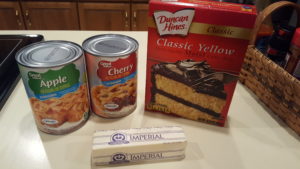
  • 2 20-ounce cans of pie filling(s) of choice (or you can make your own from scratch)

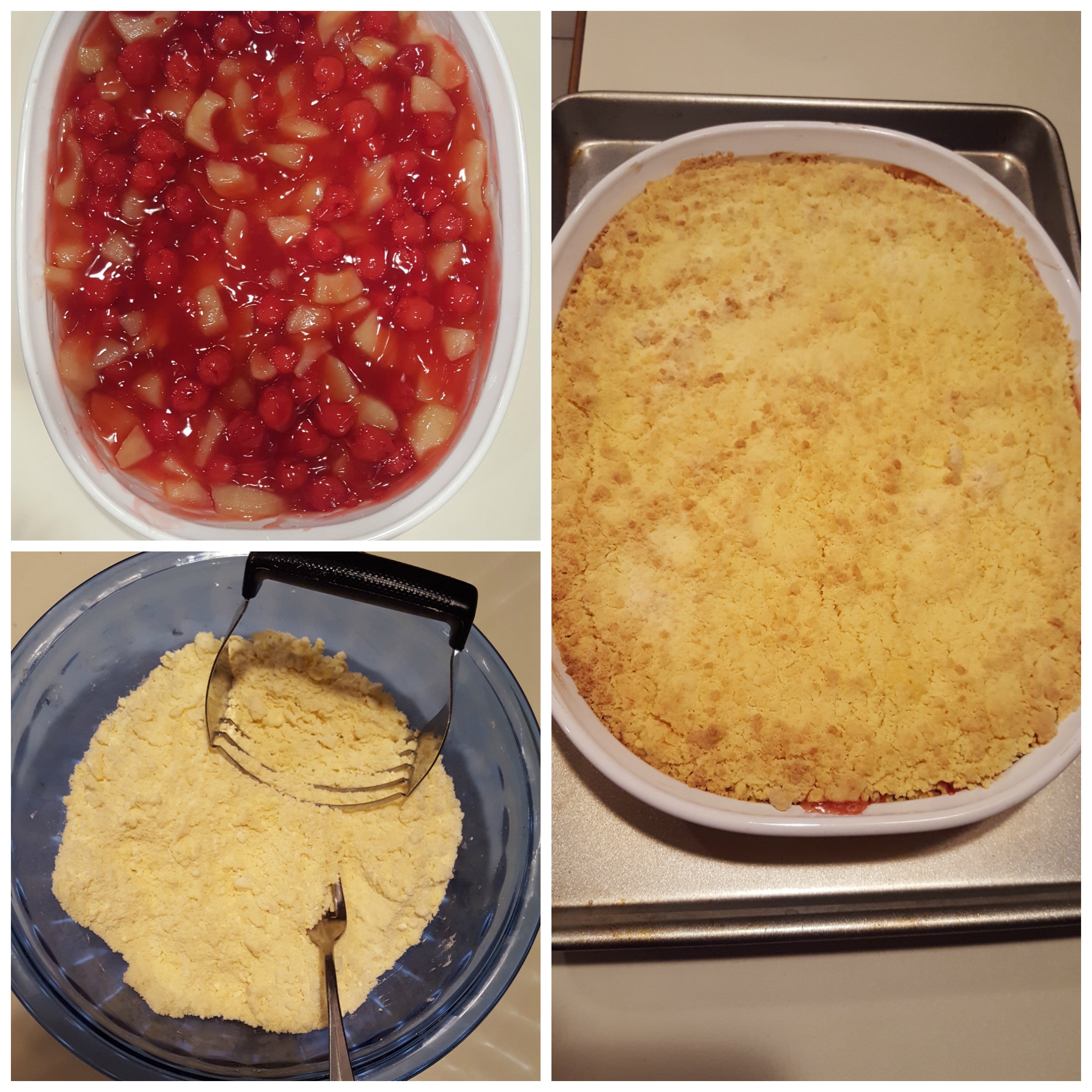
We usually like apple or cherry, so my husband thought this would be a fun time to use both!

  • 1 stick Imperial margarine, room temperature (any brand is fine; I just always bake with Imperial)
  • 1 box packaged cake mix (yellow, white, or spice)

Directions:

  1. Preheat oven to 350°.
  2. Pour canned pie filling into an 11 x 7 pan (or similar size; I sometimes divide the ingredients in half and use two different pie plates to bake them in).
  3. In a separate bowl, cut margarine into dry cake mix, using pastry cutter or fork until thoroughly combined.
  4. Sprinkle cake mix/margarine mixture over the top of the pie filling and spread evenly so all the pie filling is covered.
  5. Place pan on cooking sheet (it often runs over!).
  6. Bake 30–35 minutes, until golden brown on top.

Allow to cool for 10 minutes-ish and then cut into pieces or scoop onto plates and serve alone (that’s how we like it best) or with a small scoop of ice cream or a dollop of whipped cream on top.

Stores well, tastes great cold, and reheats easily in the microwave. And…I confess…it’s good for breakfast the morning after you’ve had guests! (Joe eats his in a bowl with a little vanilla coffee creamer poured over the top of it. Not my thing, so I eat mine plain, but hey, when you’re grownups, and you’re eating cobbler for breakfast, you can eat it however you want to!)

Enjoy! I certainly loved reading your e-mails and messages about the Come on Over Chicken many of you made last week, so I’d love to hear your follow-up reports in the comments below once you’ve tried THIS recipe and have said to friends or family, “Come on over!”


Trusting the Instrument Panel

The Captain’s Corner

When I think of my career as a pilot—starting at age fifteen and lasting nearly fifty years—I am fascinated by how much the word trust surfaces in both the physical and mental activity of flight. Trust is relying on someone or something completely external to one’s person. It extends to the design and construction of the aircraft, its maintenance, the loading and fueling of the aircraft before flight, and also the professionalism of the air traffic controllers during flight to keep two airplanes from being in the same place at the same time. Of course, the passengers are trusting the pilots and flight attendants to help them have a safe and enjoyable flight to their destination.

But let’s focus on the pilots and their environment. In flying’s early days, the idea was commonly accepted that pilots could and should fly in any kind of weather—just take off and settle down in the clouds, though they couldn’t see the ground. Soon (and often with the tragic result of the pilot losing control of the airplane) the aviation industry realized that pilots could not rely on their natural sense of balance to keep the plane right-side-up in the clouds. Thus, the concept of “blind flying” (as it was originally called) came into practice.

Blind flying became known as “instrument flying.” In instrument flying, the pilot is trained to completely ignore his or her sense of equilibrium and trust the instrument panel to tell him or her the balance, position, and direction of the flight. This trust in the instruments is absolute. The life of everyone aboard the plane completely depends on it. “Trust your instruments; don’t believe your sense of balance!” flying instructors would preach. With training, practice, and experience, this trust becomes second nature and routine.

Trusting the flight instruments pictures the example of saving faith (trust) in Christ Jesus as personal Savior. Author Paul Chappell, in his book Disciple, writes: “Everyone trusts in something. Even atheists rely on their faith that God does not exist. Far more important than the quality or nature of our faith is the object of our faith. It is only when we trust in Jesus Christ that we find salvation, the forgiveness of our sins, and eternal life with Christ” (emphasis mine).

“It is better to trust in the Lord than to put confidence in man” (Psalm 118:8, KJV).

“And there is salvation in no one else; for there is no other name under heaven that has been given among men by which we must be saved” (Acts 4:12, NASB).

Who is the object of your trust?

____________________________

Joe Henderson, Brenda’s husband, is a retired international airline captain and now blogs in “The Captain’s Corner” on a regular basis.

Would you like to receive these posts in your Inbox? We won’t spam you! You will only receive e-mails from us when a new post appears on the blog. Click here to subscribe.

Priorities

Your spouse matters.

Your children matter.

Your extended family matters.

Your work matters.

Your community matters.

Your church matters.

Your “down time” matters.

You matter.

God matters more.

When He matters most, the rest of what matters falls into place.

“But seek ye first the kingdom of God, and his righteousness;
and all these things shall be added unto you” (Matthew 6:33, KJV).