
Petals from the Basket

Blog

Celebrating Love on What Would Have Been My Parents’ 64th Wedding Anniversary

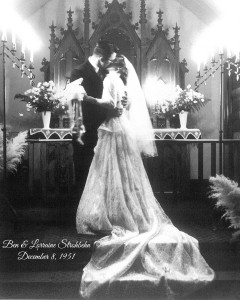
Today, December 8, would have been my parents’ 64th wedding anniversary. Following my father’s death in January of this year, my mother is choosing to celebrate this as a day of treasured memories. So today, I am sharing this tribute that I wrote in February of this year. I wish to honor the relationship they chose to commit to as they fostered, grew through, worked through, and rejoiced through the  love, companionship, and friendship they shared—all of which found their roots in Christ’s love.

*****

In the true spirit of transparency, I’ll admit it: I’m a hopeless romantic. Oh sure, in my heart I want to be—and try to be—the girl who says, “Oh, I don’t need flowers or chocolates or diamonds. You should give that money to the poor and help feed children around the world.” Really, I know that’s true, and that it’s the best use of funds, and that it’s what truly matters. But I must confess that if the truth were known, I’d have to admit that I want dozens of yellow roses, boxes and boxes of chocolates, and the biggest diamonds in all the land.

And I know I’m not the only one (though your favorite color of rose or flower may differ from mine)!

Maybe it’s just a girl thing—maybe it’s just me. But when I think of love, all too often I think of “romance.” Yes, true romance is a demonstration of the love two people have for one another, and it generally entails the positive, nice to gaze upon, easily framed picture of love. But love itself is so much more.

Oh, I’ve always known that my parents were hopelessly and wonderfully in love. They held hands constantly, and after washing and drying the supper dishes, they would kiss—right there in the kitchen for all the world to see! And they still did this after sixty-three years of marriage. It was sweet, genuine, and driven by the most precious love I’ve ever seen in action.

But in this past year, already in my fifties, I think I finally woke up and saw love from the front-row seat of reality, and I realized that its magnitude ran far deeper than the romantic outpourings of its touches, kisses, gifts, and caring words. With eyes wide open, I saw what love really looks like, and although on many levels, “it ain’t pretty,” at its core, it’s the most beautiful of all human gifts, as seen in the descriptive phrases from 1 Corinthians 13:4–8 (NIV).

Love is patient. When my father needed something, he would ring a bell if my mother or I were out of the room. While many of us (and by us I refer to myself) would be tempted to throw the bell into the nearest Dumpster after multiple back-to-back rings, with each ring of the bell, my mother would walk in and ask in gentle, loving tones, “How may I help you, my sweetheart?”

Love is kind. I saw my mom not only respond in kindness to my father this past year, but in spite of probing questions from people who cared, I never heard her speak unkindly about my father.

It does not envy. On more than one occasion, I heard both of my parents say that they wouldn’t trade “this time” (meaning the time of Mom’s providing care and of Dad’s becoming more frail, but from within the walls of his own home) for anything. They didn’t envy the health of others or begrudge each other’s talents, gifts, or moments of attention.

It does not boast. The way I see it, boasting represents an outward show for outward praise. Mom could have told the world all that she was doing behind the scenes because of her love for Dad. But in the quietness of an average bedroom in an average house in an average town, my parents generously and privately gave each other the gift of true, enduring love.
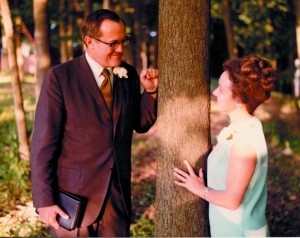
It is not proud. Being a caregiver for a spouse who is gradually becoming more and more physically incapable requires a level of humility that suddenly makes the sparkle of a diamond grow very, very dim.

It does not dishonor others. To his very last day of speaking, my father honored my mother by his words and by his actions. She returned that honor at every given moment of every given day. This is indeed a rare gift. But it exists. I saw it with my own eyes and heard it with my own ears, and I realized that honor most often shows up in words of gratitude.

It is not self-seeking. I will not ever forget seeing my eighty-three-year-old mother lying on the floor next to my father’s bed night after night so that, in spite of the difficulties that come from sleeping on a hard floor, she would be right there when he called out for help in the night. (We later insisted that she use an inflatable air mattress, and she was able to keep that right next to his bed as well.)

It is not easily angered. Love doesn’t make excuses for someone else, but it does allow you to see the explanations behind their actions. Excuses cover or try to preempt anger. Explanations provide the level of understanding that is the result of truly loving someone.

It keeps no record of wrongs. Next time you want to dredge up the list of things your spouse has done wrong or hasn’t done right in order to “win” an argument, gain control, or have your own way, I want you to remember that in my parents’ last days together, those things no longer mattered. Love not only threw away the list; it had never kept a list to begin with!

Love does not delight in evil but rejoices with the truth. It would be so easy to focus on death and dying when its certainty is inevitable, but my parents chose to focus on life. Yes, death was going to be gain, so it was talked about with the delight of seeing Jesus face to face rather than with the “woe is me” focus that would have taken everyone’s eyes off of the One who is the way, the truth, and the life.

It always protects. Sometimes protecting someone means loving that person enough to walk beside him or her through the hurts that you cannot prevent. I believe that Mom would have taken every symptom of Parkinson’s on herself, but instead, she protected my dad from going through them alone.

Always trusts. Trust is a powerful element of love. It provides both the impetus and the reward for giving all that you are with all that you have to the one you trust and to the one who is trusting you.

Always hopes. I thought long and hard about this one, because I do not want to misrepresent any of these illustrations of love. But I can say with sincerity that in the midst of this past year of “final days,” I never saw my parents lose hope. It is true: God’s faithfulness provides “strength for today and bright hope for tomorrow.”

Always perseveres. The fact that I am able to post this list of ways in which I saw my parents live out genuine love for one another (and for God!) states in no uncertain terms that love endures far beyond the romance of touches, kisses, gifts, and caring words.

Love never fails. “In sickness and in health” is all-encompassing. And while my parents’ love endured and never failed, I would be remiss not to state here that God’s love is the perfect, unfailing, unconditional love that sets the standard.

So in the days ahead, as you see outward displays of affection, which are all very nice indeed, remember to see what the Bible says about what it means to truly love someone. It is there that you will see what love really looks like!

_____

This is a reposting of a blog post that I wrote in February of this year.

Are You Squandering Your Spiritual Potential?

Potential. It’s truly a powerful word. One definition for potential in the Unabridged Merriam-Webster Dictionary reads: “having the capacity for acting or being acted upon and hence for undergoing change.” While the element of change that is mentioned is worth another blog post for another time, the aspect of “having the capacity” for this change is where I want to park for a bit.
Think of the various areas of your life—social, physical, spiritual, financial, intellectual. In a moment, I’m going to ask you to truthfully evaluate how much of your capacity you are using in each of these areas. But first, an explanation and a warning:

Explanation: If I know that I can be in better physical shape, and I am choosing to eat right but not put forth the effort to exercise, ever, I’m probably only using 50 percent of my capacity in the physical realm. If I choose to increase my potential to be in better physical condition and begin exercising a couple of days a week, I may be able to say that I’m using 70 percent of my capacity in that area. The more I am deliberate about my choices and the greater the percentage of my capacity I am using, the greater my potential will be in that area.

Warning: My “capacity meter” is not the same as yours, nor is yours the same as mine. I can’t look at an Olympic runner whose long legs (and for those of you I’ve never met in person, let’s just leave it at the fact that my legs have never been nor ever will be described as long) and compare my physical capacity with hers. She may have long legs and the capacity to do great things, but if she is not choosing to train them, she may only be at 40 percent of her capacity. For the sake of this exercise, I can only look at my capacity and how I am stewarding its potential.

Okay, it’s time to evaluate and to answer this question (Don’t hurry. I’ll wait!): What percentage of my capacity am I using in the following areas:

Social?
Physical?
Spiritual?
Financial?
Intellectual?

Obviously, as a faith-based blogger, the one I’m most concerned with is the spiritual element. As I began preparing this post, it was headed in a totally different direction. But as I took this little “evaluation quiz” myself (in my ongoing efforts to share what I am personally learning—even the difficult stuff), I began looking up Scriptures to add to this post to help you with your areas of weakness. Big mistake! (Actually, big blessing!) As I read these verses (these are only a few), the words I’ve put in bold type were the ones that especially stood out to me.

“But if from there you seek the Lord your God, you will find him if you seek him with all your heart and with all your soul” (Deuteronomy 4:29, NIV).

“‘Do not be afraid,’ Samuel replied. ‘You have done all this evil; yet do not turn away from the Lord, but serve the Lord with all your heart‘” (1 Samuel 12:20, NIV).

“Trust in the Lord with all your heart; do not depend on your own understanding” (Proverbs 3:5, NLT).

“If you look for me wholeheartedly, you will find me.” (Jeremiah 29:13, NLT).

It was as if God used His own words, recorded in Scripture for all time, to say directly to me, “Using anything less than 100 percent of your current capacity in the spiritual realm is not enough. Having the potential to be a spiritual leader, having the potential to love Me wholeheartedly, having the potential to be known as a child of grace and devoted follower of Christ, planning to someday fulfill your spiritual potential is not enough. Brenda, you are squandering your potential. It’s time to not only steward your time and your finances; it’s time to properly steward your potential.”

I closed my Bible and looked around for some spiritual Band-Aids! Ouch! After some intense carpet-smelling prayer of falling on my face before God, I came back to my computer to share what God was teaching me. For you, it may be another area (social, physical, financial, or intellectual). But before you skim the rest, thinking that it doesn’t apply to you because it’s not currently your area of “least capacity usage,” let me encourage you to remember that anything less than 100 percent (“all” in many of the verses above) is not acceptable to the One who created you, loved you, and paid the ultimate ransom for your sin debt. I’ll keep the rest brief, I promise. But it’s imperative to me to pass along to you the reminder I was given in each of these verses and through these thoughts: “But seek first his kingdom and his righteousness, and all these things will be given to you as well” (Matthew 6:33, NIV). The bottom line of this verse, as it relates to this post: Get the spiritual potential to 100 percent capacity, and the rest will follow!

As I took the time to evaluate this area and found myself  living “under-capacity” in my potential for the spiritual elements that should be the driving factor for every other area of my life, I found three things that stood out as distractions, thereby causing me to squander my spiritual potential. I share them here so that you can avoid them, put on the brakes and change directions if you’re in the midst of them, and move forward to reach a capacity level of 100 percent.

1. Avoid friendships that tear down your spiritual walls.

“But, Brenda, these are my friends. I need to be a light in the darkness.” And sadly, we often add, “And besides, they’re Christians.” Often when we try to be a part of the darkness under the pious guise of shining a light there, we are actually providing a light (dim though it may be) for others to join us in the darkness. If you’re truly shining a light that points to the Light, shine on! And shine brightly! Otherwise, walk out of the darkness of the friendships that are not expecting you to—or empowering you to—fulfill your spiritual potential. By surrounding yourself with those who encourage you to utilize every inch of your spiritual capacity, your light will shine like a beacon into the darkness, beckoning others to follow you into the light of His grace.

“Let your light shine before men in such a way that they may see your good works, and glorify your Father who is in heaven” (NASB, 1977, emphasis mine). [Note that they are the ones who will glorify God for having seen your light. If you’re no different from them, what is there to follow?]

2. Avoid futuristic thinking.

I confess, I have a bucket list. While I’m a goal-driven person, my bucket list sometimes bothers me. I don’t like the concept of someday. In fact, I wrote an entire post/poem about it here. (I’d encourage you to read it at some point, if you haven’t already.) For me personally, when I dwell on what I will do someday, it means I’m aware that I have the potential to do that thing or to be that kind of person, but that I’m not currently ready or willing to do so. If I know the potential is there, I must keep moving forward to fulfill that potential: 100 percent, 100 percent of the time!

3. Avoid focusing on failure (and the fear it produces).

This is the biggie for me. I mess up—a lot…and often. Even when I want to think I’m giving the appearance of having it together and successfully orchestrating the various areas of my life (and therein lies the root of the problem: I am trying to orchestrate what the Master Musician has already composed), if and when I slip up, falter, or downright fail, I become inwardly paralyzed by the fear of moving forward. “People have lost their trust in me. It’s no use trying.” “What if people think I’m a fanatic for radically making a transformation when they know I’m probably just going to mess it up again?” “My secret sin is so bad that I could never be considered a truly godly person.” Oh, precious friend, what we (I) so quickly fail to remember is this: His grace is greater! Please forgive the repetition, but I must say that again, in bold print this time: His grace is greater! And He offers it freely and daily, demonstrated by the open arms of His unconditional love!

“God’s law was given so that all people could see how sinful they were. But as people sinned more and more, God’s wonderful grace became more abundant” (Romans 5:20, NLT).

So let me ask all of us, myself included, one final, two-sided question: Will you squander your spiritual potential by stifling its growth through seeking and nurturing spiritually unhealthy friendships, dwelling on futuristic thinking, or focusing on past failures and the fear they produce, or will you fulfill your spiritual potential, thereby experiencing the untold blessings that He has waiting for you in every area of your life?

The bottom line is this: the choice is yours.

Who Speaks Truth to You?

Dial soap tastes awful. I should know. I had my mouth washed out with it when I was a very young child. (Yes, parents used to do “horrible” things like that back when I was kid…but keep reading!)

My neighbor was a “cool dude.” He was a teen who wore leather jackets and torn jeans and had an attitude that made grandmothers and mothers quiver at the mere mention of his name. And his sister was my friend, so I spent a lot of time playing in their yard. “CD” (“Cool dude”—I won’t be using names or exact ages or locations!) used some pretty rough language—often!—and when he would swear so freely, his friends would laugh boisterously. I was clueless. I just figured it was a great way to get people to laugh.

So (and you knew this was coming, I’m sure) one afternoon, my mom let me help her paint the porch door with a few brushstrokes of the indoor-outdoor paint. She warned me not to get any on the glass part of the door, because it would be hard to get off. She let me “help” (I’m sure I ended up being more of a detriment of time than a help, but my mom was nice like that) by painting around the outer edge of the lower region of the multi-paned door. Everything went well, and soon I grew weary of the grownup task and handed the paint brush back to my mother.

Mom dipped the brush into the can of paint, gently sliding it along the rim on the way out in order to scrape off the excess paint. As she raised the brush to the door, she painted one or two strokes, and as she turned to move to the other side of the window area, she got some paint on the glass. Expecting her to crack up at my mature, neighbor-inspired hilarity, I boldly told her, “Well, Mommy, now I’m going to have to beat the #@*&%! out of you!” She didn’t laugh. Go figure. Hence, the familiarity with the taste of Dial soap! I was none the worse for wear, but I was much wiser for the experience! Let’s just say my sweet mama used the Dial soap to speak truth into my life about what was right and what was wrong!

Now travel with me back to the present: 2015. I heard this week of a friend—someone who is a believer—joking about a very shallow lifestyle with some  mutual friends of ours. The common friends of ours, who seemed sincerely troubled by this behavior and were sharing it in a truly appropriate way, were saying how sad and empty (and quite honestly, pathetic) this lifestyle choice on our friend’s part clearly was.

My reply was, “So who is speaking truth to [this person]? Who is saying, ‘This isn’t right behavior for one who claims to be a Christian—one like Christ; a Christ follower and imitator’?” As I drove home later, the “paint incident” came to mind. If friends are laughing, treating sin like it’s the act of a hero, and not speaking out, the actions seem “cool” and acceptable. But if spoken to someone who says, “This is not acceptable,” a transformation and a “cleansing” can take place—IF the person recognizes the problem as sin and chooses to turn away from it with God’s help!

The reaction the speaker receives in either moment depends on the audience he or she is surrounding himself or herself with. And sadly, in some cases, we—and by “we,” I mean “I”—speak one way with one group and another way with another group. Or worse yet, we begin spending our time solely with those who make us feel comfortable, gratified, or even “heroic” in our sins.

Oh, trust me, I know it isn’t easy to be the one to say, “Hey, knock it off. God isn’t pleased with that.” If you’re like I am, the reason lies in the fact that I know I’m not perfect either, so I feel like the person will think I’m judging him or her. But what if my mom had worried about whether or not I would like her, think she was being mean, or point out all of her flaws to her? Besides the fact that she had the God-given responsibility to “guide my learning process” (which I can still honestly taste if I stop and think about it!), she was more concerned with bringing about change and with loving me enough to show me the right behavior than she was with anything else. And who knows? Had she not cared enough to lovingly confront me (with a right motivation and a right heart…and a bar of soap!), I might be walking around swearing at people whenever I jolly well please!

It’s all grounded in the motivation. It’s about the desired end result. If you want your friends to be blessed by God, you use the “iron” in your life to sharpen the “iron” in theirs. And if you want your iron sharpened—your spiritual walk, your social choices, your God-focused relationships—you will surround yourself with those who will use their lives to speak truth into yours.

It’s all about choices.

“As iron sharpens iron, so one person sharpens another” (Proverbs 27:17).

The Principle of Restorative Love

Yesterday I had lunch with three dear friends who have taken me into their “group” and made me feel welcome. (That’s not the point of this post, but it’s important to me to acknowledge that they are amazing!) We ate at a quaint little restaurant named Kelly Jae’s (some of the best guacamole I’ve had in years). Not only was the food good, but I was mesmerized by the “urban” look of the decor. Their website says it best: “Hardwood floors, brick walls and an original tin ceiling lend an urban feel and set the stage for a stunning dining experience.” It had boatloads of character, and I kind of want to take a cot with me next time and just live there!

One of my lunch companions shared with us that when she was a teenager, she worked at a dress shop that was once located in that very room. As she described her place of employment from those days, she mentioned that the brick walls had been covered by sheet rock and painted a plain, neutral color at that time. The now-black, ornate tin ceiling had apparently been a light color as well.

But at some point, the ceiling was painted a dark color, and the walls were restored to the original brick. As we looked more closely, we noticed that the wall had large cracks that had been filled, but we commented on how the flaws in the restoration were actually something that added not only to the visual interest but also to the strength and character of the wall. In other words, the restoration process added to its beauty and its value.

Something in the word restoration gripped my mind and wouldn’t let go. It really is an amazing thought. In Scripture, it’s contained in a rather familiar phrase from a commonly recited chapter: “He restores my soul” (Psalm 23:3, ESV). In fact, the word restore, or some form of it, appears several times throughout the Bible. As I found myself reading these verses and wiping the tears from my cheeks, I realized that there seemed to be a theme that was in place, and I came up with this “restoration principle”: When there is a loss (of any kind and at any level), restoration comes from a blending of that which was lost with something that will create an even stronger, more durable version of the lost element.

Let me give a few illustrations to help explain:

Think about a job loss. Sometimes a new job just doesn’t come right away (been there, done that). But restoration can and will come, even though it may take a different form. The lost job prepared us for the next thing on our path…even if that “next thing” is waiting. The waiting blends with the loss to stir in us a desire to follow our passion, use our skills, and seek the best possible place for that to happen (while we get paid for it). In situations like this, the restoration principle can encourage us to know that we will be stronger and more capable than we may have been without having walked this “detour.”

But this illustration takes it one step further, leaving us with the principle of restorative love: When love is lost (through death, divorce, a change of heart on one person’s behalf, etc.), people often try to fill the “hole” with unlike elements: a sudden compulsion to work longer hours, food, shallow dating, spending money they may or may not have to spend, etc. But these surface elements will not bring true restoration to the soul. For that to happen, the “retrievable” positive elements from the lost love must be blended with the lessons learned through the loss and the hurt, the reshaped hopes and dreams, the elements of time and patience, and the willingness to accept the joy of loving again. As a faith-based blogger, I must also point out that this kind of love must first be found in God, who loves us with an everlasting love. Then our human love will soar to new heights because it has a solid foundation in HIS love!

Just as the current restaurant has an intriguing, exposed brick wall that has been restored with a mortar similar to the original, making the wall stronger and even more beautiful through its restoration, so the Lord longs to restore our lives, our souls, and those areas in which we have suffered a loss. Where do you long for restoration today? When you allow God, in His timing and in His plan, to use like elements to strengthen the bridge between the present and the loss, you will be stronger and even more beautiful because of the restoration.

“Though you have made me see troubles, many and bitter, you will restore my life again; from the depths of the earth you will again bring me up” (Psalm 71:20, NIV).